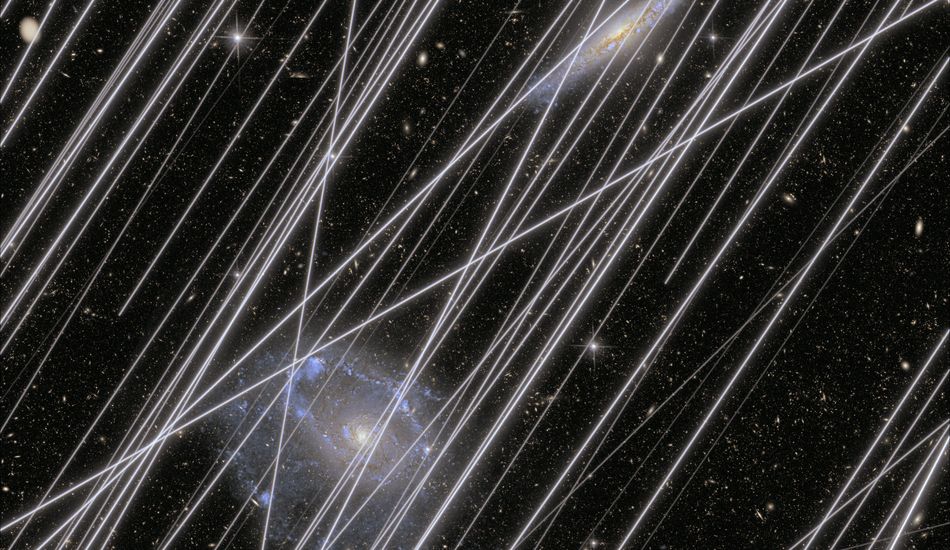
Satellite Swarms Threaten Hubble Telescope Images: Is Space Too Crowded?
It's getting seriously crowded up there! Our beloved Hubble telescope, along with others orbiting Earth, is facing a growing problem: satellite trails messing up images. Can you imagine that after all the effort to develop such a powerful and precise telescope, that something like this could compromise the quality of the images?
According to a NASA study, satellite trails could screw up nearly 40% of Hubble's images and a whopping 96% of images from other telescopes over the next decade. That's a lot! And it could really hurt our ability to spot potentially dangerous asteroids or discover new planets. The dream of having a clearer view of space is fading, all thanks to light pollution from these mega-constellations of satellites.
Alejandro Borlaff, the lead author of the study, puts it bluntly: his entire career has been dedicated to improving telescopes, only to find something that could make things significantly worse. The sheer scale of the problem is mind-boggling. With cheaper launch costs and the rise of companies like Starlink, space is becoming a chaotic free-for-all. I mean, who would have thought that launching thousands of satellites could create such a headache?
What's even more concerning is that these satellites aren't just photobombing our telescopes; they're reflecting sunlight, moonlight and even light from earth which blurs images. This reflected light can hide crucial details that scientists need to observe. For example, scientists might miss a change in a star's brightness that indicates the presence of an exoplanet, all because a satellite decided to photobomb the image at the wrong moment.
The number of satellites has tripled in the last five years, and is estimated to grow 35 times more over the next 10 years!
So, what can we do? Well, finding solutions is crucial, and fast! Some ideas include designing darker, less reflective satellites. However, this creates other problems, as these satellites tend to overheat and emit more infrared light. Another strategy is to schedule images for times when satellites are less likely to cross the field of view, but that becomes increasingly difficult as space gets more crowded.
Ultimately, it will take a collaborative effort between companies, governments, and space agencies. Maybe placing satellites in lower orbits or regulating their deployment could help. As Borlaff says, there needs to be a sustainable way for us to coexist in space. I couldn't agree more.
Source: The Verge